Wednesday, 6 September 2017

The Lincolnshire Regiment.

The Lincolnshire Regiment was the county Army Regiment of my home County, Lincolnshire, in England. It has now been amalgamated out of existence. Of passing interest is the fact that Lincolnshire natives, like me, have, or used to have, the nickname of 'Yeller Bellies' (Yellow Bellies) possibly, just possibly, due to the facing colours of the Regiments uniform in the 18th Century.
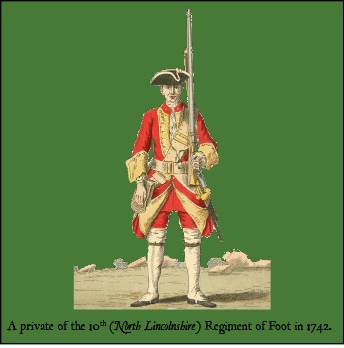

The colour in the background is Lincoln Green - the colour of Lincolnshire. This colour is also closely associated with Robin Hood.

"The Royal Lincolnshire Regiment was a line infantry regiment of the British Army raised on 20 June 1685 as the Earl of Bath's Regiment for its first Colonel, John Granville, 1st Earl of Bath. In 1751, it was numbered like most other Army regiments and named the 10th (North Lincoln) Regiment of Foot. After the Childers Reforms of 1881, it became the Lincolnshire Regiment after the county where it had been recruiting since 1781. After the Second World War, the regiment was honoured with the name Royal Lincolnshire Regiment, before being amalgamated in 1960 with the Northamptonshire Regiment to form the 2nd East Anglian Regiment (Duchess of Gloucester's Own Royal Lincolnshire and Northamptonshire) which was later amalgamated with the 1st East Anglian Regiment (Royal Norfolk and Suffolk), 3rd East Anglian Regiment (16th/44th Foot) and the Royal Leicestershire Regiment to form the Royal Anglian Regiment'A' Company of the 2nd Battalion of the Royal Anglians continues the traditions of the Royal Lincolnshire Regiment.

Battle Honours of the Lincolnshire Regiment:

Steenkirk 8 July 1692, War of the Spanish Succession 1702–1713, Blenheim 13 August 1704, Ramillies 23 May 1706, Oudenarde 11 July 1708, Malplaquet 11 September 1709, Bouchain 13 September 1711, Peninsula 1816, Sobraon 10 February 1846, Mooltan 21 December 1848, Goojuarat 21 February 1849, Punjab 1857, Lucknow 1858 1863, Atbara 1898, Khartoum 1898, Boer War 1899–1902, Pardeberg 19 February 1899, South Africa 1900–02,

Great War:
Mons, Le Cateau, Retreat from Mons, Marne 1914, Aisne 1914, '18, La Bassée 1914, Messines 1914, 1917, 1918, Armentières 1914, Ypres 1914, '15, '17, Nonne Bosschen, Neuve Chapelle, Gravenstafel, St. Julien, Frezenberg, Bellewaarde, Aubers, Loos, Somme 1916, '18, Albert 1916, '18,Bazentin, Delville Wood, Pozières, Flers-Courcelette, Morval, Thiepval, Ancre 1916, '18, Arras 1917, '18,Scarpe 1917, '18, Arleux, Pilckem, Langemarck 1917, Menin Road, Polygon Wood, Broodseinde, Poelcappelle, Passchendaele, Cambrai 1917, '18, St. Quentin, Bapaume 1918, Lys, Estaires, Bailleul, Kemmel, Amiens, Drocourt Quéant, Hindenburg Line, Épéhy, Canal du Nord, St. Quentin Canal, Beaurevoir, Selle, Sambre, France and Flanders 1914–18, Suvla, Landing at Suvla, Scimitar Hill, Gallipoli 1915, Egypt 1916

Second World War:
Vist, Norway 1940, Dunkirk 1940, Normandy Landing, Cambes, Fontenay le Pesnil, Defence of Rauray, Caen, Orne, Bourguébus Ridge, Troarn, Nederrijn, Le Havre, Antwerp-Turnhout Canal, Venraij, Venlo Pocket, Rhineland, Hochwald, Lingen, Bremen, Arnhem 1945, North-West Europe 1940, '44–45, Sedjenane I, Mine de Sedjenane, Argoub Selah, North Africa 1943, Salerno, Vietri Pass, Capture of Naples, Cava di Terreni, Volturno Crossing, Garigliano Crossing, Monte Tuga, Gothic Line, Monte Gridolfo, Gemmano Ridge, Lamone Crossing, San Marino, Italy 1943–45, Donbaik, Point 201 (Arakan), North Arakan, Buthidaung, Ngakyedauk Pass, Ramree, Burma 1943–45"

Note: It didn't serve in North America during the slight trouble we had with the Colonists there in the 18th Century.

(Information from Wikipedia)

The march of the Regiment was The Lincolnshire Poacher:

When I was bound apprentice in famous Lincolnshire
Full well I served my master for more than seven year
Till I took up with poaching, as you will quickly hear
Oh! 'tis my delight on a shiny night, in the season of the year

As me and my comrades were setting of a snare
'Twas then we seed the gamekeeper - for him we did not care
For we can wrestle and fight, my boys and jump o'er anywhere
Oh! 'tis my delight on a shiny night in the season of the year

As me and my companions were setting four or five
And taking up on him again, we caught the hare alive
We caught the hare alive, my boys, and through the woods did steer
Oh! 'tis my delight on a shiny night in the season of the year

I threw him on my shoulder and then we trudged home
We took him to a neighbour's house, and sold him for a crown
We sold him for a crown, my boys, but I did not tell you where
Oh! 'tis my delight on a shiny night in the season of the year

Bad luck to every magistrate that lives in Lincolnshire
Success to every poacher that wants to sell a hare
Bad luck to every gamekeeper that will not sell his deer
Oh! 'tis my delight on a shiny night in the season of the year

https://www.youtube.com/watch?v=MJdRxUPTKvU

The official flag of Lincolnshire is:


It has only existed since 2005 however. The red cross is the Saint George's Cross representing England. Yellow represents the crops grown in the county, as well as the nickname "Yellowbellies" given to people born and bred in Lincolnshire. Blue represents both the sea of the East coast and the wide skies of Lincolnshire, and green symbolises the rich lushness of fenland fields. The fleur de lys is a recognised symbol of the City of Lincoln.

The flower of Lincolnshire is the common dog-violet:


Just for information and interest.

Friday, 1 September 2017

Was Adolf Hitler a Socialist?: Preface.


Recently there has been an argument flying around about the question of was Hitler a socialist. It is, I think, a really stupid question. What difference does the answer, whatever it may be, make? I will admit that my immediate emotional reaction is "Of course he was!". 

But, upon reflection, I have to say that Hitler, personally, was probably not a socialist. He was an opportunistic, romantic, racist, nationalist gambler.

However, my immediate emotional (beware emotional responses!) reaction to the question is based on the idea that the ideology of fascism shares the same roots as the other great destroyers of the 20th Century - Communism and Socialism. Nazism was a form of Fascism, just a lot more racist than fascism generally. So around Hitler arose a whole body of ideological fantasising that was clearly more socialist than Hitler was. I don't think Hitler cared too much about it. He was prepared to exploit any situation that would help him up the ladder of power. He became an almost a religious figure in the Germany of the 1930's. And he was quite happy to exploit that too. If one scours his speeches on can find a snippet that supports any view - he was a socialist, he wasn't a socialist. He was Christian, he was an atheist and so on.

However, as I mentioned above Fascism, as an ideology, shares the same roots and goals as Socialism and Communism.

When I was a student, over 40 years ago (Oh no, the old man talks!) I did some courses in politics. The professors and lecturers, many no more than 10 years older than I was at that time, accepted it as an obvious, well documented, fact that these three ideologies were connected. Were variations on the same theme.

These professors and lecturers, by the way, stood head and shoulders, intellectually, above the average university professor of today. They were the product of a system that valued genuine scholarship, sound empirical evidence and sound argumentation. I knew that some of them were socialist, but that did not appear to affect their teaching or their scholarship. So I put a lot of weight on their arguments. I was, at that time, a serious Marxist by the way.

In broad terms these ideologies have several things in common:
  1. Prioritise the collective over the individual;
  2. The use of state power to achieve their ends;
  3. A hostility to free enterprise and capitalism;
  4. A tendency to romanticise aspects of their ideological position;
  5. A focus on 'collective identities' - such as nation, race, class, the disadvantaged and to romanticise these too;
  6. A tendency to create an almost religious dogma to which one must adhere - this varies but is always there; 
  7. A tendency to create a pantheon of 'saints and sinners';
Now, I am aware that many of these points apply to other social phenomena too. One could argue that they are always present in any large collective of human beings. Identity politics on a grand scale. And all states stand on a monopoly of the use of force, and all states will use it. But these ideologies exploited these traits and refined them into an almost religious system. In fact, I regard most ideologies as 'religious' and most religions as 'ideological'. 

This is just an off the cuff ad hoc drafting of some thoughts I have, hence the word 'Preface' in the title.I do intend to write more on this when I have time. So it could be quite a while yet before I do.

Not that it makes any difference to anything in the world what I write or say. But, I just feel the need to do so.

Peace.


Si vis pacem, para bellum


Islam delenda est

Sunday, 27 August 2017

Welcome to Oceania.


Yes, I know. I go on and on about this. A lot of people, much more influential than me, go on and on about it also. But I am angry. I am frustrated. I am very sad. I am in a deep existential depression and I seriously believe that the Enlightenment project is dead, liberty is dying and before long we will be having show trials …. if we aren’t already, show trials by social media anyway.

We are living in Oceania already.

We have already got – thought crime (extreme political correctness in its many forms), thought police (the guardians of social media and the corrupt institutions of main stream media), doublethink (the application of one standard of behaviour to one group and another standard to another group), newspeak (where words like free speech have lost all meaning and been redefined), the memory hole (as history is rewritten and distorted to suit the contemporary ‘narrative’), 2+2=5 (as people are required to express belief in totally false dogma to keep their jobs, social status, even liberty), the telescreen (as we are almost all linked to the internet which is closely watched and censored by powers that have no accountability.), the two-minute hate (hell, one week hate, one month hate, one year hate – on social media primarily) non-persons (people who have breached one of the multitude and often contradictory rules who ‘disappear’ from their jobs, public life and social media).

Room 101 hasn’t, as far as I know, appeared yet. But it will I fear.

The show trials by social media will soon, I am really afraid, become a reality. One could argue that some of the judicial actions against ‘thought criminals’ come into this category already. And then how far behind come the ‘disappearing’s ’ even the executions?

Paranoid? You bet your bloody life I am paranoid – Just because you are paranoid doesn’t mean they’re not out to get you.

Afraid? You bet your bloody life I am afraid.

For example, has any one else experienced the following?:

  1. When doing a Google search if the topic is a bit conservative, the top results are often nothing like what one was looking for. For example, I searched for a picture that was ‘pro-capitalist’. The vast majority of the pictures that came up were anti-capitalist.

    I have experienced this when searching for serious articles dealing with topics like gender and race. Anyone else experienced this?
  2. I have also noticed a distinct slowing of response times when clicking on certain links – definitely slower than other, less controversial, links.

Paranoia? Maybe. Faulty internet connection? Maybe. I hope so, but I don’t know.

YouTube has recently begun a massive purge of material. People who are critical of the current ‘narrative’ are having their videos demonetised or even ‘memory-holed’.


Google now dominates, almost totally, the internet and has gathered more information on individuals (you and me) even than state organizations do. Google is a part of corporate capitalism, however, paying millions of dollars to lobby the US Congress. It can be seen as a part of the states ‘outsourcing’ of surveillance.


YES … I know they are private companies and can do what they like, and I abhor the state regulation of private companies, as some people are asking for. But they are carefully editing a ‘world view’ and the CEO has even stated that ‘making people better people’ is a goal (there is a video of him saying this, but of course I cannot find it now!)

So, what to do? Google has no real competitors at this time. Luckily, there are alternatives to YouTube appearing:


We are already living in the world of 1984. Things are not totally bleak …. yet. Although European civilization is now hanging by a very thin thread indeed, I believe that the USA is in a stronger position. At the very least, if it comes to a real fight, they have a lot of conservative people with weapons.

SO …. welcome to Oceania.

BIG BROTHER IS WATCHING YOU.


Wednesday, 9 August 2017

The Things that I hold to be True.

I have been attempting to clarify my thoughts on a range of issues and to pin down what it is that I truly believe and would be prepared to stand up for. At my age it may well seem a little late I suppose, but I have tended to flop around a bit and I think I am at a point where I need to do this. Or, at least, try to do this.

I am an old, heterosexual, white, male – that makes me public enemy number one in these enlightened times, I know. I am English by birth and British by politics and law. Of both of these, I am very proud.

My ontological and epistemological positions can be summed up as follows:

I believe that there is a real reality out there that we can know the truth about. That reality may often not fit our wishes and ideological predilections, but it is there and we have to learn to live with it.

What I am about to list are things that I think are definitely true or more than likely to be true, or are, at least, reasonable. The positions that I take are based on sound science, sound empirical data, sound logic and sound reasoning. I am prepared to stand up and to argue for all of the claims I am about to make.

  1. There are two sexes. Male and female.
  2. There are cognitive and emotional differences between the two sexes.
  3. There are cognitive and emotional differences between different genetic populations. In the old days, we would say races. But the modern concept of genetic populations doesn’t quite fit the old divisions.
  4. Within a given population there is variation, usually a normal distribution, of cognitive and emotional development, skills, abilities and so on.
  5. The individual is the only unit of analysis and legal status that matters. To reduce individuals to the average qualities of some fictitious social grouping of which they are by chance a member – nationality, race, gender, social class and so on is to commit a basic logical blunder.
  6. The individual is the only unit of political, social and economic analysis that matters.
  7. Human beings are biological machines, a product of evolution, and carry within them a range of cognitive and emotional mechanisms shaped by that evolution
  8. As much as we try to, we cannot escape our biological nature, that we will live, age and die and that we have certain behavioural predispositions because of our chthonic nature.
  9. Free will, as traditionally understood, is a myth. Maybe a necessary one, but a myth.
  10. There are no ontological entities beyond the material. In other words, all religions and spiritual notions are just fairy stories. I am aware that some people, with whom I otherwise am very much in agreement, won’t like this. But, there it is. The only religious framework that has ever attracted me is Buddhism, particularly Zen Buddhism. Zen has no gods and no transcendental entities and is more of a philosophy of life than a religion. However, there is a European philosophy that is very similar to Zen, and recently I have become very interested in it, again. That philosophy is Stoicism. I think that Stoicism lost out to the myth and fascination of the ‘Mystical east’.
  11. Capitalism, while far from perfect, is the best system yet devised by humanity for the production and distribution of economic goods. Due to capitalism humanity has been lifted as far above its dependence on brute nature as is possible to go.
  12. Democracy … Mmmmm, democracy is extremely problematic. Riddled with difficulties and always in danger of being reduced to base populism. However, I somewhat reluctantly accept it is better than most alternatives. I confess that I have a soft spot for a monarchy, but that is maybe a little old fashioned.
  13. While climate change is happening I am not convinced that it is more than part of the normal fluctuations of climate on this planet. There have been some huge variations in the past.
  14. Ecological, or organic, foodstuffs and products are, to be crude, BS*. BS in great big steaming heaps.
  15. Alternative energy sources are also, largely, BS. I am a committed believer in and supporter of nuclear power. Nuclear power would solve all our energy problems.
  16. Alternative anything is usually BS too. For example, if ‘alternative medicines’ work, then they are medicine are they not?
  17. I am not a pacifist. There are some things that I would definitely fight for. At my age and in my physical condition, I would last about 30 seconds in a war zone. But, for the right cause, I would be there.
  18. Socialism and all its variants are the evilest political ideology ever to arise in the history of humanity. They have killed millions and ruined the lives of millions more.
  19. I support minarchist libertarianism. That is to say, ideally, there should be no State, but recognising certain realities the State is necessary to provide a certain minimum framework of law, order and defence for individuals to pursue there lives. A night watchman State. And, once upon a time, I was a Revolutionary Marxist can you believe!
  20. Apart from the minimum structure supplied by the State, all other services would be supplied by the market or voluntary associations, based on demand.

Well, that turned into a bit of a rag-tag semi-rant didn’t it? And there are some contradictions in there, and I am aware of them, I think. However, that is ‘The Things I hold to be True.’


If you read this, then thank you.

*(In case you don't know BS = Bullshit)

David Bruce Curtis - 9th August 2017 - Torp, Denmark.

Sunday, 2 July 2017

Crete and me.


I have recently returned from another wonderful two weeks on the island of Crete. I ask myself, sometimes, why I always feel so at home on Crete. Why do I feel more 'myself' there than anywhere else? Why does it feel, to use a cliché, as if there is a 'David shaped hole' on Crete that I perfectly fit.?

I have often reflected over this. Is it because, and I exaggerate a little here, that I travel from the cold, clenched, Protestant and regimented north to the warm, open, Orthodox and anarchistic south? That I move from feeling like a wind up toy to feeling like warm honey melting out over the brown and rocky landscape?

Is that too florid? But it captures something of what it feels like..

The climate, of course, is part of it, although I have yet to spend a winter on Crete. But in the spring and summer one can almost guarantee warmth and unbroken sunshine. Of course there are dull days, and very occasionally there is rain, and that can be very heavy. But, the rain doesn't last long, in the summer. Yes, there are days that aren't so good. But usually all one has to consider is the heat, and it can get hot. It can reach 40 degrees C. That is hot! But, on average, the temperature is around 30 degrees, give or take. And the humidity is low, compared to northern Europe, so one does not feel so uncomfortable.

In that sunshine and warmth the weather fades away as an issue. One can do whatever one chooses without having to think about the weather. And life is much more public, as in so many Mediterranean countries. Sitting in a taverna, drinking coffee, and watching the world go by.

And the terrain of Crete is so special. Rocky. Wild. With real mountains that have remote little villages and hidden little valleys, nooks and crannies. A very special atmosphere. It is, of course, cooler in the mountains, and therefore it is greener. The terrain of the lowlands is very brown in the summer. I love the mountains. To see the mighty White Mountains on the horizon gives me a pleasurable chill, an emotional reaction, ever single time I see them.


The wildlife, too, is fascinating. There are, of course, goats everywhere, but they are not wild. The national animal of Crete is a wild goat, the Kri-Kri. They only exist, now, on three small offshore islands.


But there are birds, my great love. There are eagles, vultures, pelicans, owls, kestrels and many smaller species. As I love raptors it is wonderful for me. To see an eagle soaring in a valley high up in the mountains, that is a very special feeling, for me.


There are no poisonous animals on Crete. There are four species of snake, but I have yet to see one. There is a huge amount of insect life, especially ants, or so it seems sometimes. They fascinate me too. There are several species of scorpion, but the sting of the most deadly of these is no worse than a mosquito bite.

And, of course, cicadas. Some people find their chirping irritating, but I don't. That sound IS Crete for me, in many ways. A dark night, sitting on the terrace, feeling a slight breeze and hearing the song of the cicadas. Lovely.


And the history of Crete, the history. A wonderful, incredible history. It is a history of occupation and resistance, in many ways. I will come on to that.

But first, right back at the beginning, in the misty dawn of time, a civilisation flourished on Crete that was sophisticated culturally and technologically. That civilisation has been called the 'Minoan' civilisation since at least Karl Hoeck used it in 1825, but it is more closely associated with the great archaeologist, and discoverer of Minoan culture, Arthur Evans. He excavated, amongst others, the most famous palace of the Minoan era, Knossos, just south of Heraklion.

Minoan civilisation, and it is not known what they called themselves, was the first fragile stirring, the first 'link in the chain', as it has been called, of the greatest culture the world has ever seen - European.

Knossos.


Minoan Bull

Minoan Axe


Reconstruction of life at Knossos


That grabs me. Here, so long ago, the roots of Europe began to establish themselves.

Then, the Minoan civilisation fell, and natural disasters where a factor in this. The civilisation had faded away by about 1200 BCE and Crete underwent periods of occupation and turbulence.

The Mycenaean Greeks were the first conquerors. There appears to have been a period of aristocratic rule and city states. Crete was conquered by the Romans in 71 BCE, for being on the wrong side in a war, and was grouped with Cyrenaica to become the Roman province of Creta et Cyrenaica, with the capital at Gortyn.


Roman rule slowly segued into Byzantine rule.

The island was dominated by arabs from the 820's, for about 150 years, actually becoming the Emirate of Crete. The Byzantine Empire reconquered the island in 961 and expelled the Arabs.


Anyway, I am rambling on. I love history and I never know when enough is enough.

After the Fourth Crusade in 1204 the Byzantines lost control of Crete to the Venetians. Venice ruled Crete, known as the Kingdom of Candia, from 1212 to 1669 (over 400 years). Candia is the city of Heraklion today.


Candia (Heraklion)

The Venetian influence can be seen in, for example, the town of Chania today. The harbour was Venetian, many of the streets and street names in the Old Town are Venetian, and the remains of the massive fortifications are Venetian.

The Venetian presence fueled a renaissance in art, of which possibly El Greco is the most well known representative today.

However, life was hard for the Cretans under the Venetians. As non-Catholics (Greek Orthodox) they suffered heavy taxes and not many civil rights. I don't know of any rebellions or resistance by the Cretans during this period, but I cannot imagine that there were none at all.

Then, in 1669, after a 21 years long siege, Candia fell to the Ottoman Turks and Crete became a part of the Ottoman Empire for 200 years. Mainland Greece successfully rebelled against the Ottomans starting in 1821, and Crete followed suit with the Cretan Revolt of 1866 to 1869, finally overthrowing the Ottomans.


The mosque in Chania.


Crete was an independent state until 1908 when they voted for unification with the mainland of Greece.

The  200 year long muslim presence is not visible in Crete today. In Chania the mosque is now an exhibition centre. Of course, in 1923 the Greeks and the Turks exchanged populations. Orthodox Greeks in Turkey, who had been suffering persecution and had begun to flee, were swapped with Muslims living in Greece. This meant that Greece did not have, and does not have, a Muslim population as such to this day.

During the period of Ottoman occupation there were several attempts at rebellion and continual resistance by the Cretans. This is a fascinating and detailed story in its own right, but I will leave it there. The greatest epic of Cretan resistance was, of course, during the German occupation from May 1941 to the end of the war. Under the occupation Greece as a whole suffered more than any other occupied country except for Poland, and their resistance was one of most effective in Europe.


I appear to have rambled on anyway. But the point of this, besides outline what fascinates me about Crete, is to look at the culture and the people of the island. This landscape, this climate, and this history has shaped both the culture and the people of this place.

Yes, I love the food here. Nothing can beat fresh Cretan oranges or fresh tomatoes for example. And the olive oil is second to none. I love the music, too, the traditional Cretan music and dance. This does carry a trace of arabic/ottoman influence.


But, it is the people that truly make a place. It is people that truly matter. And the people of Crete are ... well, they are magnificent.

The Cretans are Cretans first, and Greeks second. They are very proud, and very independent. For a 100 generations and more they have resisted central authority, and they still do. They are anarchistic. The most important social unit is the family, and the village. The extended family and the village are often the same thing anyway. They are open, and extremely generous. They love life and they enjoy life. But, despite the myths, they also work very, very hard. They work hard to extract an existence from the world they inhabit, and they play very hard too.

However, I have never seen a Cretan drunk. Yes, they drink alcohol in pretty impressive amount sometimes, but they dance, and they drink a lot of water at the same time. Maybe that's why?

The pace of life is slow, and when a Cretan says they will come on Saturday, for example, you aren't sure which Saturday they mean.
  
Some people we know went to a Cretan wedding. There were over 1,000 guests and they provided, between them, all the food and drink. There were also a group of young men from the mountain villages, all dressed in traditional Cretan clothing. And, of course, firearms were discharged. At any major event guns are fired into the air.

Up in the mountains you can see where road signs have been used, a lot, for target practice. It is said that there are more weapons on the island than people. A lot were left after World War 2 was over of course, and disappeared into people's homes.

In the remoter villages it can feel as if one has gone back in time by about 100 years, as if there really is no connection with the modern world. That is, until a young man pulls out his iPhone of course.


The people of Crete ... I love them. Funny, proud, independent, fiercely loyal to family, open and hospitable ... anarchistic. 

In the final analysis, although everything else I have said is true, I think it is the people and their culture that suits my own personal outlook and views more than anything else.

And, I must include this. A wonderful, wonderful clip:


Monday, 5 June 2017

"It is better to die on your feet than to live on your knees." Emiliano Zapata


I am tired of this, really tired. And I cannot understand the apparently endless patience of my fellow countrymen and women. This ideology kills. This ideology poisons all that is good and positive about our culture. This ideology, the creation of a vicious barbaric warlord, is spreading like syphilis in a port town. It, obviously, must be dealt with, and dealt with directly, and soon. 

Or else all will be lost.

Our elites still refuse to confront the reality of the situation, that Islam is not compatible with any form of civilised life or culture and must be pushed back into the hell holes it comes from.

Or we will find ourselves living in such a hell hole.

Where is the spirit, the motivation, that lead our young men into the fight against what was at the time the worst evil the world had seen - Nazism? What would they think if they came back today and could see our civilisation being picked slowly to pieces by an alien ideology and, what is more, apparently aided and abetted by our own elites, our own politicians and our own, new, version of fascism - Social Justice-ism?

Surely, surely to god, it is better to die standing up, as Emiliano said?

Where is the fight going to come from? Where are the new Crusaders when we need them, ready to fight an apocalyptic crusade?

I am so tired of this.

I am tired of the lies and distortions spread by Islam and its fellow travellers. The lie of the Crusades. The lies about Muhammad. The lies about the content of the ideology itself.

Don't we know enough now, to act? Haven't we experienced enough, now, to see straight through the smokescreens and the 'explanations' and the justifications and the lies? Where is a Churchill when you need him?

I am 64 years old, and would die within seconds in a fight. But I would rather that than live in a 7th Century hell hole.

But it is for our descendants we must fight. What will they think of our failure? What will they think when our legacy to them is a primitive and barbaric culture?

Maybe I am too pessimistic. I know that there are people bravely standing up to be counted. But what happens to them? Vilified. Mocked. Banned. Arrested. We are already living in a society that is the advance guard of an Islamic state.

There is a huge, smelly, fæces encrusted elephant in the room, and those who are pointing it out get attacked.

Fight, or bend the knee - which is it to be?

Si vis pacem, para bellum
¤

Carthago delenda est

Wednesday, 24 May 2017

Manchester 2017


I am angry. I am furious. I am boiling. Another Islamist attack. Another group of people whose lives are taken, or shattered forever for the sake of a primitive, medieval death cult.

Enough is, surely, enough?

Despite my boiling rage I think that it is very important that we react with cold reason and hard logic. In an act of fury we are no better than the monster who took the lives of concert goers in Manchester.

Europe has allowed an utterly alien fascist ideological movement to settle in the nooks and crannies of their various social groups. From there Europe has allowed the poisonous ideology to spread via radical Mosques and appeasement from our politicians, cheer led by our so-called 'progressive' elites. The ancient and varied cultures of Europe are being rapidly undermined by Islamofascism. The fruits of the greatest civilisation and culture ever to grace this planet, and I mean Western Enlightenment civilisation, are being destroyed by this ideology.

But the blame lies with, as I said above, our mealy mouthed and weak politicians and with the equally wicked form of fascism generally known as 'progressivism' or 'Social Justice-ism'.

How long are we going to stand for this?

Now, in my homeland, we have soldiers on the streets and a heightened security state. And the powers that be say 'Carry on as normal'. How the hell is that 'normal?????

We have allowed this to happen, by being afraid of being labelled 'racist' or 'islamophobic'. Once again, Islam is not a race, and to be afraid of Islam is not irrational, it is a perfectly rational fear based on long and painful experience.

I think, maybe, that people will begin to take retaliatory measure on their own, and that is understandable. The fear with that is that all remnants of the rule of law will collapse, and that can only hasten the collapse of Western Civilisation. It will also allow a wide variety of other groups, equally as frightening as Islamofascism, to emerge from the undergrowth. It will open the doors to vigilantism, vendettas and criminal activity.

So, what can we do?

We can continue to speak out, unafraid of smear attacks, and we can begin to organise in larger and larger groups who have had enough, and say so loudly.

I still fear that it won't be enough, that Western civilisation is losing this war, and it is a war, and that some form of civil war will erupt. And that will be so destructive of the very elements of Western civilisation that have made it great - liberty, reason, the rule of law, freedom of speech, economic freedom, the individual's pursuit of their own happiness, science and progress.

What do we do???????

I am angry and so very frustrated.

What do we do? It cannot go on like this.

Si vis pacem, para bellum
¤

Carthago delenda est